My desire to do Rize justice by writing something even remotely smart or insightful about it is counterbalanced by my creeping exhaustion, the result of snapping awake shortly after 4 this morning and generally failing pathetically to fall back asleep. My eyes are burning and my fingers keep hitting the wrong keys and my brain pretty much shut off about an hour ago, but something has to be said about this film.
What saves Rize from being overwhelmingly feel-good treacle on the one hand or utter darkness on the other is both the believable humanity of its subjects and the excellent crafting of the film. The kids and young adults at the movie's core are determined to escape the bleak crappiness of what could be their fates as blacks in LA's less desirable neighborhoods not by means of drugs or gangs or violence but through an intensely physical form of dance.
It's amazing and uplifting to see them move; I often found myself watching with my mouth agape. They define themselves both by what they are--clowns/krumpers--and by what they're not--gangbangers, addicts, the parents who far too often let them down. For much of the film, it's possible to believe that something in the world is opening up to these dancers.
But Dave LaChappelle, the filmmaker, takes extreme care to temper that belief somewhat with proof that even the most transportive physical experience can't lift you entirely out of the mud. There's enough disappointment and senseless loss and heartache to bring you back from your music- and movement-fuelled high and remind you where the film is taking place.
Still, though, there is a sense of something unquashably hopeful here, as well as a familiar sense of awe at what amazing and creative and utterly new things can come from the worst of human experience. Just try to sit through the long, gorgeous, sunny final scene and reach the credits with dry eyes.
4.24.2006

4.22.2006
Musical Memory Lane
In what's become something of an annual event, I've spent a good chunk of today going through my cd's, copying to iTunes those that aren't there already, and posting the discs for sale on Amazon. As I'm no longer able to play cd's on anything but my laptop, I figure I should digitize all the music I want to keep and pass the originals along.
(Selling the discs is the lead-in to a complex justification of purchasing a 30G iPod to replace my trusty but out-of-space Mini, but that's a story for another day.)
It's fascinating to listen to some of this stuff again, especially since so many of these discs remind me acutely of specific times and places and people. That's a wildly unoriginal thing to say, I know, but it's also true. Poi Dog Pondering basically is Ian and Dave and 1990. Drivin' n' Cryin's Mystery Road so brings me back to countless hours of hanging out with Jeff and Chris in my room circa ninth grade that I can see the polka dotted wallpaper and can feel the eternally uncomfortable squishy red chair. And (What's the Story) Morning Glory? puts in my head a sharply clear picture of Ry and I editing our Hershey film in the basement of New England building late in 1995.
I feel like I experience this musical memory lane thing fairly often, so I should be beyond the point at which I'm at all surprised by it. But I remain sort of amazed by the extent to which my brain has, um, a mind of its own when it comes to music: with the first few notes of a song, my head just goes where it will, dredging up random bits and pieces from within itself that I doubt I'd ever come across again otherwise.
So Dookie is hours by the pool in Niantic with my first Discman--the kind you had to keep absolutely still and level at all times--and Ten is lying in the sun on Heather's floor in Seattle in March of 1992 and Murmur is spring break with G&P in Florida and all of it is worlds away, and right here with me.
(Selling the discs is the lead-in to a complex justification of purchasing a 30G iPod to replace my trusty but out-of-space Mini, but that's a story for another day.)
It's fascinating to listen to some of this stuff again, especially since so many of these discs remind me acutely of specific times and places and people. That's a wildly unoriginal thing to say, I know, but it's also true. Poi Dog Pondering basically is Ian and Dave and 1990. Drivin' n' Cryin's Mystery Road so brings me back to countless hours of hanging out with Jeff and Chris in my room circa ninth grade that I can see the polka dotted wallpaper and can feel the eternally uncomfortable squishy red chair. And (What's the Story) Morning Glory? puts in my head a sharply clear picture of Ry and I editing our Hershey film in the basement of New England building late in 1995.
I feel like I experience this musical memory lane thing fairly often, so I should be beyond the point at which I'm at all surprised by it. But I remain sort of amazed by the extent to which my brain has, um, a mind of its own when it comes to music: with the first few notes of a song, my head just goes where it will, dredging up random bits and pieces from within itself that I doubt I'd ever come across again otherwise.
So Dookie is hours by the pool in Niantic with my first Discman--the kind you had to keep absolutely still and level at all times--and Ten is lying in the sun on Heather's floor in Seattle in March of 1992 and Murmur is spring break with G&P in Florida and all of it is worlds away, and right here with me.
4.15.2006
Why He Hates Canadians
Having recently finished Will Ferguson's Why I Hate Canadians, I can sum the book up thus: he doesn't.
Oh, sure, he has some bitter things to say about separatist Quebecois, and cringes at the evident scourge that is general Canadian niceness, and relentlessly mocks Farley Mowat, and gets understandably pissy at those who rail against "hypenated Canadian identities" (e.g., Chinese-Canadian). But in the end, his real venom seems to be reserved for--wait for it--American Patriots.
Now, my grasp of American history is, by this point, fairly pathetic, and far be it from me to put up much of a defense of my country's oft-wrongheaded ways, but really? The Patriots? I suppose it would be anathema to American public school history class curricula to present a sympathetic view of the Loyalists, and perhaps that's why Ferguson's portrait of them seems so bizarrely soft, so weirdly one-sided. All I know is that reading his alternative view of the American Revolution raised in me the unusual desire to stand up against the Canadian view of things.
Why the vitriol? Is it because the Patriots were all truly the rich, misguided, raving assholes Ferguson makes them out to be, or is it because decrying the Revolutionaries almost automatically involves celebrating the Loyalists, who, not coincidentally, became some of the first European Canadians? Could it be that Ferguson doth protest too much?
I found the chapter on Loyalists-cum-Canadians especially irksome and amusing in light of the fact that it's closely followed by a chapter called "America Is Sexy," in which Ferguson outlines what he calls "the...five (5) axiomatic propositions of Canadian Nationalism vis-a-vis the Americans:
Oh, sure, he has some bitter things to say about separatist Quebecois, and cringes at the evident scourge that is general Canadian niceness, and relentlessly mocks Farley Mowat, and gets understandably pissy at those who rail against "hypenated Canadian identities" (e.g., Chinese-Canadian). But in the end, his real venom seems to be reserved for--wait for it--American Patriots.
Now, my grasp of American history is, by this point, fairly pathetic, and far be it from me to put up much of a defense of my country's oft-wrongheaded ways, but really? The Patriots? I suppose it would be anathema to American public school history class curricula to present a sympathetic view of the Loyalists, and perhaps that's why Ferguson's portrait of them seems so bizarrely soft, so weirdly one-sided. All I know is that reading his alternative view of the American Revolution raised in me the unusual desire to stand up against the Canadian view of things.
Why the vitriol? Is it because the Patriots were all truly the rich, misguided, raving assholes Ferguson makes them out to be, or is it because decrying the Revolutionaries almost automatically involves celebrating the Loyalists, who, not coincidentally, became some of the first European Canadians? Could it be that Ferguson doth protest too much?
I found the chapter on Loyalists-cum-Canadians especially irksome and amusing in light of the fact that it's closely followed by a chapter called "America Is Sexy," in which Ferguson outlines what he calls "the...five (5) axiomatic propositions of Canadian Nationalism vis-a-vis the Americans:
- Boy, we hate Americans.
- We really do.
- Really.
- I'm not kidding. We really hate them.
- So how come they never pay us any attention?"
Another insightful Canadian shared something similar with me several years back, and I've always found it funny because it seems so painfully true. We Americans are apparently like the junior high school boys to Canadians' mature and sweet tween girls: they think we're overly loud and obnoxious and full of ourselves and immature and impoolite and sometimes kind of jerk-like and...hey! Hey! How come they won't sit at our lunch table? Hey! Where are they going? Don't they think we're cute?
Of course we think you're cute. But we're too enchanted by the brassy eighth graders who will laugh at our Beavis and Butt-Head references and make out with us behind the cafeteria during study hall to pay you much mind.
Ferguson's vaguely curmudgeonly reconsideration of the American Revolution (to which I can't help feeling the puckish desire to retort, Sorry, perhaps we, too, should still be tied to the crown of England) doesn't detract from the rest of his book, which is an insightful, interesting, and sometimes laugh-out-loud funny ramble through various bits and pieces of Canadian history and culture. It was, all told, a painless--and even pleasurable--way to ingest some Canadiana, and I'm looking forward to reading his other stuff.
4.09.2006
Two (Depressing) Views of the Sex Trade
Chugging along in my quest to catch up on good movies I've missed, I returned to Into Video last week and brought back Born into Brothels and Hustle & Flow. Only once I'd already checked them out did I realize they're both portraits of prostitution, though from radically different viewpoints.
Born into Brothels portrays a group of seven kids who, as the title suggests, were brought up in the red light district of Calcutta. Their potential salvation comes in the form of a photographer who believes these kids' lives are worth documenting in pictures and who gives them cameras and photography classes to that end.
Brothels won the Best Documentary Feature Oscar in 2004, and rightly so, I think: it's a stunning and thoughtful look at lives that are often abysmal but not without hope. It's painful to see these kids interact with the adults in their lives, a shocking proportion of whom slap them with swear-laden invective time and again. But amazingly, and much to their credit, the children largely stand up for themselves: one girl, having been roundly berated at the brothel well by one of the prostitutes, simply expresses shock at the woman's dirty mouth and politely carries her buckets back up the stairs.
It's imperative, I think, to watch the "where are they now?" feature on the DVD after watching the movie itself, because the follow-up softens the somewhat harsh ending of the film, showing that a few of the kids that seemed most in danger when the filmmakers left them have since moved on to better things. But the film on its own is a testament to a sort of superhuman strength--emotional, if not physical--that can be tapped into under the right (or, as the case may be, utterly wrong) conditions. It's a tiny flare of hope in a world of so much grief.
So what to make of Hustle & Flow? I so much wanted to love it, both because I was impressed with Terence Howard in Crash and because I'd heard him and H&F's director speak really eloquently about the film on "Fresh Air." But in the end, presenting a pimp as a sympathetic character is a tough sell, at least to this crowd.
I watched H&F with Dana and Jenn, who, by the end of the film (and for most of the "Behind the Scenes" feature) sat with their mouths agape, aghast at what was happening on screen. The movie is unabashed in its wish for us to care most about Howard's Djay, more even than we care about the prostitutes working for him; in "Behind the Scenes," the filmmakers come out and say that the film is one in which the women are meant to stand behind their men.
Fair enough, I suppose--it is a film about a pimp, after all, and the next strongest characters are the men helping him record the songs he hopes will be his ticket to a better life. But if it's hard out here for a pimp, it's even harder for a ho, and the movie doesn't even begin to go there.
Maybe I'd feel more fondness for Hustle & Flow if I'd watched it on its own, rather than the night after I saw Born into Brothels, when that film was still so fresh in my mind. And maybe I expected to much of Terence Howard (and Ludacris, for that matter) after Crash. I just know that, although I was willing to suspend judgment and keep myself open to the possibility of feeling sympathy for an unsympathetic character, the movie let me down. Here's hoping it's not Terence Howard's greatest legacy.
Born into Brothels portrays a group of seven kids who, as the title suggests, were brought up in the red light district of Calcutta. Their potential salvation comes in the form of a photographer who believes these kids' lives are worth documenting in pictures and who gives them cameras and photography classes to that end.
Brothels won the Best Documentary Feature Oscar in 2004, and rightly so, I think: it's a stunning and thoughtful look at lives that are often abysmal but not without hope. It's painful to see these kids interact with the adults in their lives, a shocking proportion of whom slap them with swear-laden invective time and again. But amazingly, and much to their credit, the children largely stand up for themselves: one girl, having been roundly berated at the brothel well by one of the prostitutes, simply expresses shock at the woman's dirty mouth and politely carries her buckets back up the stairs.
It's imperative, I think, to watch the "where are they now?" feature on the DVD after watching the movie itself, because the follow-up softens the somewhat harsh ending of the film, showing that a few of the kids that seemed most in danger when the filmmakers left them have since moved on to better things. But the film on its own is a testament to a sort of superhuman strength--emotional, if not physical--that can be tapped into under the right (or, as the case may be, utterly wrong) conditions. It's a tiny flare of hope in a world of so much grief.
So what to make of Hustle & Flow? I so much wanted to love it, both because I was impressed with Terence Howard in Crash and because I'd heard him and H&F's director speak really eloquently about the film on "Fresh Air." But in the end, presenting a pimp as a sympathetic character is a tough sell, at least to this crowd.
I watched H&F with Dana and Jenn, who, by the end of the film (and for most of the "Behind the Scenes" feature) sat with their mouths agape, aghast at what was happening on screen. The movie is unabashed in its wish for us to care most about Howard's Djay, more even than we care about the prostitutes working for him; in "Behind the Scenes," the filmmakers come out and say that the film is one in which the women are meant to stand behind their men.
Fair enough, I suppose--it is a film about a pimp, after all, and the next strongest characters are the men helping him record the songs he hopes will be his ticket to a better life. But if it's hard out here for a pimp, it's even harder for a ho, and the movie doesn't even begin to go there.
Maybe I'd feel more fondness for Hustle & Flow if I'd watched it on its own, rather than the night after I saw Born into Brothels, when that film was still so fresh in my mind. And maybe I expected to much of Terence Howard (and Ludacris, for that matter) after Crash. I just know that, although I was willing to suspend judgment and keep myself open to the possibility of feeling sympathy for an unsympathetic character, the movie let me down. Here's hoping it's not Terence Howard's greatest legacy.
4.05.2006
I Love Kayak
Expedia, Orbitz, Travelocity, and your ilk: I'm through with you.
Sidestep and Mobissimo: I still like you, but maybe we should take a break for a while.
The travel search site that's the new apple of my eye is Kayak, which kicks everyone else's ass. It's more flexible than Sidestep, returns more relevant results than Mobissimo, and doesn't levy any crappy fees like the mega-mall sites. It lets you search a whole mess of airlines (or hotels, or cars, or packages), then gently scoots you directly to the site of the provider you choose--with the flight or hotel you selected ready and waiting for you to buy.
And though, like all new and different and scruffy and irreverent stuff on the web, it's surely bound to be snatched up by some goliath as soon as it gets popular enough, for the time being it remains new and different and scruffy and irreverent. (Witness the Labs page, described thus: "This is where we release experimental stuff. Try it out and let us know which tools are useful and which ones are stupid." What's not to love?)
I'm sure there's all sorts of technically brilliant stuff happening on this site--compendia of results from other sites, crazy RSS feeds of several stripes, some sort of IM interface something or other--that those more electronically inclined than I will appreciate. All I know is that when all other sites failed, Kayak found me a cheap flight to New York that didn't involve leaving from San Jose and/or flying overnight. For that, and for its general kick-ass-ness, I am smitten.
Sidestep and Mobissimo: I still like you, but maybe we should take a break for a while.
The travel search site that's the new apple of my eye is Kayak, which kicks everyone else's ass. It's more flexible than Sidestep, returns more relevant results than Mobissimo, and doesn't levy any crappy fees like the mega-mall sites. It lets you search a whole mess of airlines (or hotels, or cars, or packages), then gently scoots you directly to the site of the provider you choose--with the flight or hotel you selected ready and waiting for you to buy.
And though, like all new and different and scruffy and irreverent stuff on the web, it's surely bound to be snatched up by some goliath as soon as it gets popular enough, for the time being it remains new and different and scruffy and irreverent. (Witness the Labs page, described thus: "This is where we release experimental stuff. Try it out and let us know which tools are useful and which ones are stupid." What's not to love?)
I'm sure there's all sorts of technically brilliant stuff happening on this site--compendia of results from other sites, crazy RSS feeds of several stripes, some sort of IM interface something or other--that those more electronically inclined than I will appreciate. All I know is that when all other sites failed, Kayak found me a cheap flight to New York that didn't involve leaving from San Jose and/or flying overnight. For that, and for its general kick-ass-ness, I am smitten.
4.04.2006
Wanderlust
Having sworn that my two-week European jaunt this September would pre-empt much of my other travel for the year, I now find myself to be something of a liar.
DC in May is still up in the air--maybe, maybe not, depending on the vagaries of my sort-of employer and the cost of plane tickets--but there will definitely be a New York excursion for about a week in early June, followed by a foreshortened Fam summer binge in July, followed perhaps by something Vancouver-ward if my bank account can bear it. So I've been spending inordinate amounts of time ping ponging back and forth between airline sites, trying to be wise in my ticket purchasing and ruing the fact that my $250 Boston ticket last month is a deal unlikely to be repeated for the remainder of the year.
Transportation logistics aside, I've also managed to lose myself for hours in researching hotels in Italy, which has made me realize that the (relative) grandeur of our 2002 accommodations is much less feasible in this post-corporate world I currently inhabit. But I'm looking, and making vague promises to myself about cutting back on other expenses (such as, um, well, something) to be able to fund another grand tour, and recalling fondly all of the amazing places J and I stayed last time around.
(For some reason, one of the memories that bubbles closest to the surface is our night in Nice, after a less-than-ceremonious arrival that included witnessing an attempted carjacking of the vehicle in front of us on our way into the city. But with wine and dinner and a stroll through the city, we got beyond that, and at the end of it all fell asleep in our stunningly nice room in a hotel whose name, if I'm not mistaken, included "Palace."
Still jetlagged, though--this was my third night abroad--I woke up early, spurred awake, no doubt, by the clamor coming from down the street, which filtered up into the room through the French doors that we'd left open for air. After tossing and turning for a few minutes, I got up to see where the noise was coming from, and determined that there were a clatch of workmen doing something or other involving jackhammers on the road below. I watched blearily for a while, then fell back into bed, and possibly back into some sort of sleep.
J woke to the same noise shortly thereafter, and, seeing my eyes flutter, asked, "What is that?" "They're doing some jackhammering down the street," I replied, to which he said, "How do you know?" "I got up and looked," I said. He then fixed me with something between disbelief and amusement. "I love that you got up to confirm the source of the jackhammering, and yet left the windows wide open.")
So I really should be writing the articles that have been tugging at my sleeve for the past few weeks, or tending to some vague stab at spring cleaning, or doing any of the dozens of other things that are relevant and pressing now. But it's all I can do not to lose myself entirely down the rabbit hole of travel to come.
DC in May is still up in the air--maybe, maybe not, depending on the vagaries of my sort-of employer and the cost of plane tickets--but there will definitely be a New York excursion for about a week in early June, followed by a foreshortened Fam summer binge in July, followed perhaps by something Vancouver-ward if my bank account can bear it. So I've been spending inordinate amounts of time ping ponging back and forth between airline sites, trying to be wise in my ticket purchasing and ruing the fact that my $250 Boston ticket last month is a deal unlikely to be repeated for the remainder of the year.
Transportation logistics aside, I've also managed to lose myself for hours in researching hotels in Italy, which has made me realize that the (relative) grandeur of our 2002 accommodations is much less feasible in this post-corporate world I currently inhabit. But I'm looking, and making vague promises to myself about cutting back on other expenses (such as, um, well, something) to be able to fund another grand tour, and recalling fondly all of the amazing places J and I stayed last time around.
(For some reason, one of the memories that bubbles closest to the surface is our night in Nice, after a less-than-ceremonious arrival that included witnessing an attempted carjacking of the vehicle in front of us on our way into the city. But with wine and dinner and a stroll through the city, we got beyond that, and at the end of it all fell asleep in our stunningly nice room in a hotel whose name, if I'm not mistaken, included "Palace."
Still jetlagged, though--this was my third night abroad--I woke up early, spurred awake, no doubt, by the clamor coming from down the street, which filtered up into the room through the French doors that we'd left open for air. After tossing and turning for a few minutes, I got up to see where the noise was coming from, and determined that there were a clatch of workmen doing something or other involving jackhammers on the road below. I watched blearily for a while, then fell back into bed, and possibly back into some sort of sleep.
J woke to the same noise shortly thereafter, and, seeing my eyes flutter, asked, "What is that?" "They're doing some jackhammering down the street," I replied, to which he said, "How do you know?" "I got up and looked," I said. He then fixed me with something between disbelief and amusement. "I love that you got up to confirm the source of the jackhammering, and yet left the windows wide open.")
So I really should be writing the articles that have been tugging at my sleeve for the past few weeks, or tending to some vague stab at spring cleaning, or doing any of the dozens of other things that are relevant and pressing now. But it's all I can do not to lose myself entirely down the rabbit hole of travel to come.
4.02.2006
Ludacris Made Me Cry
Last night I shuffled over to Into Video and returned with Curb Your Enthusiasm, Season 2, Disc 1, and Crash (the 2005 version, not the crazy Cronenberg-Spader-sex-with-corpses version). I watched Curb first, figuring I'd coat my stomach with some delightful ridiculousness before the depressing punch of Crash. A wise move, as it turned out.
Crash was brilliant, and if there's ever been a more roundly damning portrait of race in America, I can't imagine what it might be. One of the extremely impressive things about the movie is that almost no one--with the possible exception of the locksmith and Sandra Bullock's Latina housekeeper--gets away without doing or saying at least something prejudiced, bigoted, or otherwise assholic. Almost all of the characters show an ugly side at some point.
Much of Crash is relentlessly depressing, but it's pulled back from the brink of being as much of a downer as, say, Amores Perros by a few moments of levity and by a small handful of vaguely heartening scenes. Time and again, things just don't turn out as you think they will, for better or (often) worse, and each of the characters confounds expectations by becoming either more human or less over the course of the film.
It's not giving too much away to say that Anthony, the character played by Ludacris, takes an unexpected turn from the moment we're introduced to him to the moment we see him riding on a bus toward the end of the film. Oddly, for all of the painfully sad or brutal or bleak events throughout the story, the only time I cried was when Anthony pulled his van--stolen under complex and fairly nasty conditions--to a corner in LA's Chinatown and opened the back door. I won't give away what happens or why it induced tears, both because doing so would spoil some of the richness of the intertwining story lines and because describing the moment in words doesn't do it justice.
Suffice it to say that the filmmakers don't let Anthony escape as a fully changed character--he's still a confused, hypocritical, messed-up kid--but they do let him feel a pinprick of something like mercy. It's a stunning, heartwrenching, almost hopeful moment.
Crash was brilliant, and if there's ever been a more roundly damning portrait of race in America, I can't imagine what it might be. One of the extremely impressive things about the movie is that almost no one--with the possible exception of the locksmith and Sandra Bullock's Latina housekeeper--gets away without doing or saying at least something prejudiced, bigoted, or otherwise assholic. Almost all of the characters show an ugly side at some point.
Much of Crash is relentlessly depressing, but it's pulled back from the brink of being as much of a downer as, say, Amores Perros by a few moments of levity and by a small handful of vaguely heartening scenes. Time and again, things just don't turn out as you think they will, for better or (often) worse, and each of the characters confounds expectations by becoming either more human or less over the course of the film.
It's not giving too much away to say that Anthony, the character played by Ludacris, takes an unexpected turn from the moment we're introduced to him to the moment we see him riding on a bus toward the end of the film. Oddly, for all of the painfully sad or brutal or bleak events throughout the story, the only time I cried was when Anthony pulled his van--stolen under complex and fairly nasty conditions--to a corner in LA's Chinatown and opened the back door. I won't give away what happens or why it induced tears, both because doing so would spoil some of the richness of the intertwining story lines and because describing the moment in words doesn't do it justice.
Suffice it to say that the filmmakers don't let Anthony escape as a fully changed character--he's still a confused, hypocritical, messed-up kid--but they do let him feel a pinprick of something like mercy. It's a stunning, heartwrenching, almost hopeful moment.
3.16.2006
Terrifying Offer of the Week
From an ad for the book Love Smart:
Ready to Star in Your Own Life?
Dr. Phil has written the script.
(Um, thanks, but I think I'd prefer something by Ionesco, or even Mamet.)
***
I should note that I came across this ad while reading--yes, it's true--O, the Oprah Magazine. For some reason, O has fascinated me for years now, though I only ever picked it up in the gym or during an airport layover when I could no longer bear the weight of The New Yorker and couldn't quite dip down to Us Weekly. But now I have my very own subscription, which somehow feels vaguely illicit.
It's a fascinating magazine. I assume that a good chunk of the readership also watches Oprah, which would suggest that a fair number of these women are stay-at-home moms with varying levels of disposable income. Yet O is *full* of products presented as "A few things Oprah thinks are just great" that seem well beyond the reach of many working families. These include a $200 Kate Spade gardening bag, $32 plates (yes, per), and $35 sets of cheese spreaders.
Perhaps the idea here is that there's a chunk of the magazine's audience who can easily afford all of these things (along with the heart-droppingly spendy purses, clothes, and shoes); a chunk who can shell out for a few of them; and a chunk for whom the magazine's product sections are purely aspirational.
Or maybe I'm the only one who finds a $168 t-shirt a ludicrous proposition, in which case I will vow from now on to avoid "The O List" and stick instead to Dr. Phil's tooth-achingly treacly column, Suze Orman's tough-love, you-go-girl financial advice, and the various other features of this rag that have such a mysterious draw for me.
Ready to Star in Your Own Life?
Dr. Phil has written the script.
(Um, thanks, but I think I'd prefer something by Ionesco, or even Mamet.)
***
I should note that I came across this ad while reading--yes, it's true--O, the Oprah Magazine. For some reason, O has fascinated me for years now, though I only ever picked it up in the gym or during an airport layover when I could no longer bear the weight of The New Yorker and couldn't quite dip down to Us Weekly. But now I have my very own subscription, which somehow feels vaguely illicit.
It's a fascinating magazine. I assume that a good chunk of the readership also watches Oprah, which would suggest that a fair number of these women are stay-at-home moms with varying levels of disposable income. Yet O is *full* of products presented as "A few things Oprah thinks are just great" that seem well beyond the reach of many working families. These include a $200 Kate Spade gardening bag, $32 plates (yes, per), and $35 sets of cheese spreaders.
Perhaps the idea here is that there's a chunk of the magazine's audience who can easily afford all of these things (along with the heart-droppingly spendy purses, clothes, and shoes); a chunk who can shell out for a few of them; and a chunk for whom the magazine's product sections are purely aspirational.
Or maybe I'm the only one who finds a $168 t-shirt a ludicrous proposition, in which case I will vow from now on to avoid "The O List" and stick instead to Dr. Phil's tooth-achingly treacly column, Suze Orman's tough-love, you-go-girl financial advice, and the various other features of this rag that have such a mysterious draw for me.
3.03.2006
Fame via Complaining
Yes! Witness my 7.5 seconds of demi-fame in KPIX Consumer Watch's Problem Solvers segment on license agreements. (Look for the clip called "Problem Solvers Tackles Software Issues.")
How suave I am as I note that it's not worth my precious drips of time to read EULAs when I install software! How charming as I maintain that I'd be happy to allow someone (or something) else to do the work for me, thereby freeing me up to pour another glass of wine and polish my seemingly spotless desk! And what impressive typing skills!
(Thanks, Joshy, for letting me be your star.)
How suave I am as I note that it's not worth my precious drips of time to read EULAs when I install software! How charming as I maintain that I'd be happy to allow someone (or something) else to do the work for me, thereby freeing me up to pour another glass of wine and polish my seemingly spotless desk! And what impressive typing skills!
(Thanks, Joshy, for letting me be your star.)
3.02.2006
EUROPE
Having done well for myself thus far this year, and itching as I am for a vacation that doesn't involve anything work-like, New England, or DC, I just bit the bullet and booked myself passage (in CONNOISSEUR class, natch--and free) to Europe for two weeks this September.
I haven't been out of North America since John and I went on our Epic European Adventure in the summer of 2002, and I'm achily excited at the prospect of returning to The Continent. Explaining to J recently why now seemed like a good time for a reprise, I wrote
It's true: though 2002 is still, in many respects, the year to beat, the past few months have signaled a possible return to balanced existence again after the annus rather horribilus that, by and large, was 2005. I hold out hope not that this year's trip to Europe will be a rehash of the memories I love so well of four years ago, but rather that it will bring a raft of its own stellar moments.
So, J, ass (&c) coming your way.
I haven't been out of North America since John and I went on our Epic European Adventure in the summer of 2002, and I'm achily excited at the prospect of returning to The Continent. Explaining to J recently why now seemed like a good time for a reprise, I wrote
You should know, J, that 2002 stands out as perhaps the best year for me in recent memory, in no small part because of my various travel adventures, including the Epic etc. Though I don't want to jinx myself or the ten months that spread out ahead of me, I will say that 2006 has been pretty swell thus far, and a return to EUROPE would only help this year clinch the title of Best Yet. I am determined to do what I can to get my ass on foreign turf.
It's true: though 2002 is still, in many respects, the year to beat, the past few months have signaled a possible return to balanced existence again after the annus rather horribilus that, by and large, was 2005. I hold out hope not that this year's trip to Europe will be a rehash of the memories I love so well of four years ago, but rather that it will bring a raft of its own stellar moments.
So, J, ass (&c) coming your way.
2.26.2006
The California Dream

Before the Bay Area dipped into its (relative) cold snap a few weeks back, there were a few days that were so impossibly clear and warm--especially in the South Bay, where I've spent more than my fair share of time--that they made me wonder how I could ever even consider leaving.
Indeed, there's much to be said for our balmy mid-winter weather, which has always been one of my favorite things about living in Northern California. When it's possible to leave the house without a jacket, and perhaps to find yourself too warm regardless, it's easy to believe that you're living the sweet California dream, to fantasize about sun-soaked fields and genteel living and a sense of bright hope and all those other images that once made up the state's iconography.
The slightly less glittery reality, though, is that things are no longer quite as golden. You can still find the fields, but they're fewer and farther between, and broad swaths of the state seem to be losing them altogether. The genteel living is increasingly hard to come by as prices still (miraculously) climb, with no sign of drifting down. The hope sometimes seems to go as easily as it comes.
But maybe that's just the rain.
2.19.2006
If/Then/Eh
The Globe and Mail's Leisure Weekend newsletter appeared in my Inbox on Friday with this little bit of unrendered code in the header:
// ehhhhhhhh if (!d) { var d = document; }
My code-reading skills are beyond rusty at this point, but I'm guessing the end result here was meant to be a subtle Canadianism, or perhaps a variable particular to the Great White North.
// ehhhhhhhh if (!d) { var d = document; }
My code-reading skills are beyond rusty at this point, but I'm guessing the end result here was meant to be a subtle Canadianism, or perhaps a variable particular to the Great White North.
1.29.2006
Kerouac
I went into the Main Library the other day to scavenge for DVDs (slim pickings, though I did check out "Tanner '88," which sounds somewhat intriguing) and was stopped short in the main lobby by a poster advertising the display in the gallery downstairs: Jack Kerouac's original manuscript for On the Road. Thinking that they couldn't possibly mean the manuscript--that crazy long scroll of type--I went down to investigate.
And damn was I wrong: it was indeed the manuscript, (partially) unrolled in all of its wild, uncorrected, paragraph-break-less, nonstop glory. I won't go so far as to call seeing it a religious experience, but it was undoubtedly an amazing treat, especially as I vaguely recall reading, a few years back, about there being such disputes as to the manuscript's ownership that it was doubtful it'd be seen again in public. (Though perhaps I have that backwards, as SFPL's exhibit would suggest.)
So I spent a long time down in the gallery, walking the length of the manuscript and reading bits and pieces as I went, checking out the related exhibits (Beats in SF, Ferlinghetti on trial for Howl, a map of North America with quotations from the book, a timeline of Kerouac's life), and grinning like a nutter. I find it so easy, always, always, to fall in love with the utter impossible romanticism of the whole Beat experience, and found myself looking longingly at the photos of North Beach in the fifties, thinking, I was born too late.
But that romantic ideal never holds for very long: the fifties in which Kerouac and Co. did good chunks of their writing were also the fifties in which a book like Howl could be (and, of course, was) confiscated for indecency, in which even San Francisco remained somewhat buttoned up, in which societal norms were worlds away from what they are now. And I can't imagine a better symbol of how the Beat dream imploded than the photo on display of a bloated and alcohol-weary Kerouac, circa 1967, looking years and miles away from his Sal Paradise heyday.
Still, it was amazing to see the original incarnation of a work that had such an impact on my early adult years (and that still makes me pine for a life I could never live), to look at the scroll (fragile now, but still legible, and still showing penciled-in markup) and lose myself for a while in imaginings of an era and a San Francisco and an artistic movement now gone.
It stayed with me--all of it--as I walked out of the gallery and back upstairs and out again into the relatively unromantic and un-Beat San Francisco of 2006.
And damn was I wrong: it was indeed the manuscript, (partially) unrolled in all of its wild, uncorrected, paragraph-break-less, nonstop glory. I won't go so far as to call seeing it a religious experience, but it was undoubtedly an amazing treat, especially as I vaguely recall reading, a few years back, about there being such disputes as to the manuscript's ownership that it was doubtful it'd be seen again in public. (Though perhaps I have that backwards, as SFPL's exhibit would suggest.)
So I spent a long time down in the gallery, walking the length of the manuscript and reading bits and pieces as I went, checking out the related exhibits (Beats in SF, Ferlinghetti on trial for Howl, a map of North America with quotations from the book, a timeline of Kerouac's life), and grinning like a nutter. I find it so easy, always, always, to fall in love with the utter impossible romanticism of the whole Beat experience, and found myself looking longingly at the photos of North Beach in the fifties, thinking, I was born too late.
But that romantic ideal never holds for very long: the fifties in which Kerouac and Co. did good chunks of their writing were also the fifties in which a book like Howl could be (and, of course, was) confiscated for indecency, in which even San Francisco remained somewhat buttoned up, in which societal norms were worlds away from what they are now. And I can't imagine a better symbol of how the Beat dream imploded than the photo on display of a bloated and alcohol-weary Kerouac, circa 1967, looking years and miles away from his Sal Paradise heyday.
Still, it was amazing to see the original incarnation of a work that had such an impact on my early adult years (and that still makes me pine for a life I could never live), to look at the scroll (fragile now, but still legible, and still showing penciled-in markup) and lose myself for a while in imaginings of an era and a San Francisco and an artistic movement now gone.
It stayed with me--all of it--as I walked out of the gallery and back upstairs and out again into the relatively unromantic and un-Beat San Francisco of 2006.
1.22.2006
We still need to create better software
I went to Office Depot yesterday intending to buy padded envelopes and managed to leave with three new pieces of software (along with a ream of paper, a flash drive, and the aforementioned envelopes), which I blame on the Turbo Tax promotion the store is currently running.
Though I haven't yet been able to psych myself up to actually install TT, I was excited enough at the prospect of being more anal than ever about my personal finances that I popped Quicken into the computer as soon as I got home. And, well, hmm.
Not having the benefit of much experience with earlier versions of the program, I can't say for sure whether Quicken 2006 represents much of an improvement, if any at all. I can say that it's somewhat underwhelming. The UI manages to be both too rudimentary and far too busy at the same time (a fact that's true, I might add, of perhaps a majority of applications on the market today), and though the start-up wizard did help me get my basic info entered properly, it still felt like it didn't take me far enough.
There are some odd quirks (slash bugs?), too. Why, for example, did something listed as a deposit in my bank register manage to morph into an expense category in the program's budget tool? How did Quicken surmise that I'll be $90K in debt by the end of the year? (I mean, yes, my rent is high, but not that high.) Why didn't it figure out that all "Usps" entries in my credit card registers should be standardized to "USPS," with an expense category of "Postage," after I told it multiple times?
I can write these frustrations off as part of a learning curve, and some of them, I imagine, will disappear in time. But what of QuickBooks, which I've been using for a year now with my business? Although I have Simple Start--which, as the name suggests, is as basic as you can go in the QB universe--I still find myself perplexed by some of its behaviors. Why, for example, does it list every invoice I've ever created as unpaid, despite the fact that I meticulously follow the program's prescribed formula for tying incoming payments to outstanding invoices? And why doesn't it recognize that credit card bill payments in my bank register are not new expenses in and of themselves?
When I mentioned to Otis yesterday that I'd installed Quicken, he replied that he'd tried to start using the program dozens of times and have given up in frustration again and again. Surely he can't be alone.
Nor can Intuit. How many creators of software (not to mention Web sites) track not just how many users they acquire, but how many of those people are actually able to use their programs for their intended purposes? Usability, user-centric design, and creating better user experiences may be the buzz, but how often are these practices truly and effectively put to use? Why are there still so many programs that are so full of small frustrations? (And why, dammit, does IE have such a problem with new windows stealing focus? It drives me to drink.)
I can't say I'm exactly aching to get back into the world of UX, but this morning, after wrangling with Quicken to download some credit card info, I found myself starting to design the personal finance program I'd actually want to use. And I began to wonder how many people I could lure away from Quicken (or Peachtree, or Microsoft Money)--how many people would breathe a sigh of relief at a program that focused on doing fewer things and doing them better (and more easily) rather than on doing a whole raft of things many people aren't interested in.
There are, I'm sure, millions out there who are drawn to bells and whistles, whether because they actually use them or because they merely think they should, or like the idea that they're there in the first place. But there also have to be millions more who want simpler programs that do basic tasks with a modicum of fuss. Who's designing for those people (yours truly among them)?
Though I haven't yet been able to psych myself up to actually install TT, I was excited enough at the prospect of being more anal than ever about my personal finances that I popped Quicken into the computer as soon as I got home. And, well, hmm.
Not having the benefit of much experience with earlier versions of the program, I can't say for sure whether Quicken 2006 represents much of an improvement, if any at all. I can say that it's somewhat underwhelming. The UI manages to be both too rudimentary and far too busy at the same time (a fact that's true, I might add, of perhaps a majority of applications on the market today), and though the start-up wizard did help me get my basic info entered properly, it still felt like it didn't take me far enough.
There are some odd quirks (slash bugs?), too. Why, for example, did something listed as a deposit in my bank register manage to morph into an expense category in the program's budget tool? How did Quicken surmise that I'll be $90K in debt by the end of the year? (I mean, yes, my rent is high, but not that high.) Why didn't it figure out that all "Usps" entries in my credit card registers should be standardized to "USPS," with an expense category of "Postage," after I told it multiple times?
I can write these frustrations off as part of a learning curve, and some of them, I imagine, will disappear in time. But what of QuickBooks, which I've been using for a year now with my business? Although I have Simple Start--which, as the name suggests, is as basic as you can go in the QB universe--I still find myself perplexed by some of its behaviors. Why, for example, does it list every invoice I've ever created as unpaid, despite the fact that I meticulously follow the program's prescribed formula for tying incoming payments to outstanding invoices? And why doesn't it recognize that credit card bill payments in my bank register are not new expenses in and of themselves?
When I mentioned to Otis yesterday that I'd installed Quicken, he replied that he'd tried to start using the program dozens of times and have given up in frustration again and again. Surely he can't be alone.
Nor can Intuit. How many creators of software (not to mention Web sites) track not just how many users they acquire, but how many of those people are actually able to use their programs for their intended purposes? Usability, user-centric design, and creating better user experiences may be the buzz, but how often are these practices truly and effectively put to use? Why are there still so many programs that are so full of small frustrations? (And why, dammit, does IE have such a problem with new windows stealing focus? It drives me to drink.)
I can't say I'm exactly aching to get back into the world of UX, but this morning, after wrangling with Quicken to download some credit card info, I found myself starting to design the personal finance program I'd actually want to use. And I began to wonder how many people I could lure away from Quicken (or Peachtree, or Microsoft Money)--how many people would breathe a sigh of relief at a program that focused on doing fewer things and doing them better (and more easily) rather than on doing a whole raft of things many people aren't interested in.
There are, I'm sure, millions out there who are drawn to bells and whistles, whether because they actually use them or because they merely think they should, or like the idea that they're there in the first place. But there also have to be millions more who want simpler programs that do basic tasks with a modicum of fuss. Who's designing for those people (yours truly among them)?
1.10.2006
Passportage

Better than 1996's photo, for sure.

While going through immigration in Vancouver a few years back (it may have been late 2001, in which case I sort of understand), I was grilled by the agent whose desk I'd approached. He asked me where I was headed, how long I'd been in Canada, what I'd done while in Vancouver (Um, do I have to answer that? In detail?), where I worked, what my job title was, and on and on.
He held my passport open in his hand and kept looking from it to me, then back to the passport and back to me. Finally, he told me he was so skeptical because the photo in my passport looked nothing like the present me. "It's the bridge of the nose," he said. "Usually, no matter how much anything else about you changes, the bridge of your nose will still look the same, and yours doesn't."
I resisted the urge to snidely comment that perhaps the policy whereby adult US passports are valid for ten years was not a good one, as any number of people were bound to look different
1.09.2006
When is an Ektorp not an Ektorp?
I've lately come off of a home improvement bender of sorts, which was spurred on by a number of things, among them the discovery of something mildew-esque on the backs on my sofa cushions.
In the immediate wake of this discovery, I went at said cushions with a sponge and my hairdryer, then realized a.) I probably was doing nothing beneficial at all, and b.) it's beyond time to get a new slipcover for my sofa, anyway. So I braved the crowds at Ikea (not as bad as anticipated, but still) and found an impossibly cheap ($21!) blue slipcover for the Ektorp loveseat I own. How thrilling! How pleased I felt with myself, having scored such a serious bargain (slipcovers normally go for $100 and up--why, I don't know)! How excited I was to come home, strip my sofa down, and re-clothe it in something new and mildew-free!
How very wrong I was. Because who knew, first off, that the Ektorp loveseat is not the same thing as the Ektorp SOFABED loveseat? (Yes, fine, it should've been obvious, but I was blinded by what I may have mentioned was a heart-stoppingly cheap price.) I figured I could work around that first hurdle somehow, preparing to get out some scissors and make alterations as needed. But then I discovered that even if I were to do some creative cutting, the damn cover was nowhere near the right size.
I mean, OK, Ikea. You sell stuff that's hardly of heirloom quality, and your product names are generally impossible to pronounce, and there's always something new and different happening within your walls. But did you actually modify one of your products just enough that no post-2004 slipcover will fit my 2002 sofa? Or has the Ektorp loveseat always been three-and-a-half inches shorter than the Ektorp SOFABED loveseat? And why do the back cushions seem to be exactly the same size? The mind boggles.
Luckily, I scored equally good deals on my new Ringum rug (yes, it's round), Limbo lamps, and Lots self-adhesive wall mirrors. But still, how utterly bittersweet to come so close to something that could've been so good and beautiful and right only to find myself foiled by Swedes.
In the immediate wake of this discovery, I went at said cushions with a sponge and my hairdryer, then realized a.) I probably was doing nothing beneficial at all, and b.) it's beyond time to get a new slipcover for my sofa, anyway. So I braved the crowds at Ikea (not as bad as anticipated, but still) and found an impossibly cheap ($21!) blue slipcover for the Ektorp loveseat I own. How thrilling! How pleased I felt with myself, having scored such a serious bargain (slipcovers normally go for $100 and up--why, I don't know)! How excited I was to come home, strip my sofa down, and re-clothe it in something new and mildew-free!
How very wrong I was. Because who knew, first off, that the Ektorp loveseat is not the same thing as the Ektorp SOFABED loveseat? (Yes, fine, it should've been obvious, but I was blinded by what I may have mentioned was a heart-stoppingly cheap price.) I figured I could work around that first hurdle somehow, preparing to get out some scissors and make alterations as needed. But then I discovered that even if I were to do some creative cutting, the damn cover was nowhere near the right size.
I mean, OK, Ikea. You sell stuff that's hardly of heirloom quality, and your product names are generally impossible to pronounce, and there's always something new and different happening within your walls. But did you actually modify one of your products just enough that no post-2004 slipcover will fit my 2002 sofa? Or has the Ektorp loveseat always been three-and-a-half inches shorter than the Ektorp SOFABED loveseat? And why do the back cushions seem to be exactly the same size? The mind boggles.
Luckily, I scored equally good deals on my new Ringum rug (yes, it's round), Limbo lamps, and Lots self-adhesive wall mirrors. But still, how utterly bittersweet to come so close to something that could've been so good and beautiful and right only to find myself foiled by Swedes.
12.20.2005
2005
This morning, while steering with my knees as I drove up Sacramento Street, chatting with Ry on my cell phone, and trying to sip from a cup of hot coffee from S**r**cks (hey, someone gave me a gift card, so the joe was free), I realized two things: 1.) I am currently my own worst nightmare (though I wasn't driving an SUV, so perhaps not quite); and 2.) I am crazily happy.
Eventually I hung up the phone, put the coffee in my cup holder, and placed both hands back on the wheel, thereby ending #1 (own worst nightmare), but #2 still held fast. And, really, it wasn't just the caffeine jolt or the video game-esque thrill of driving the hills of San Francisco with no hands or even the hilarious joy of talking with Ryan, though all of those were quite pleasant. It was those things and the general sense of well-being that has trumped even my loopy exhaustion this month.
Because here, at the tail end of the year, it finally feels like some things that were up in the air for a long time have started to drift back down to earth, where I most need them to be. Though they may not (indeed, probably won't) stay down here forever, what matters is that they're here now. That's a sorely welcome relief.
When I went out for a run this evening, it was already dark; halfway down Dolores Street, it started to rain--not enough to get me wet, really, but enough to make me realize there was indeed water falling from the sky. For a while I tucked my head down and tried to quicken my pace. But then The Decemberists came up on my iPod, and I thought of laughing with Ry this morning, thought of two phone conversations I'd had earlier this week, of the utter joy (really, it was awesome) of my party this past Saturday, of the holidays with my family and friends in the week ahead. I thought about how far this year has brought me, and about what 2006 might hold.
And then, rain and the chance of looking truly starkers be damned, I actually raised my arms above my head, mouthed the words to the song coming into my ears, and ran with my head high, grateful and amazed and, here at the bottom of December, so much at peace.
Eventually I hung up the phone, put the coffee in my cup holder, and placed both hands back on the wheel, thereby ending #1 (own worst nightmare), but #2 still held fast. And, really, it wasn't just the caffeine jolt or the video game-esque thrill of driving the hills of San Francisco with no hands or even the hilarious joy of talking with Ryan, though all of those were quite pleasant. It was those things and the general sense of well-being that has trumped even my loopy exhaustion this month.
Because here, at the tail end of the year, it finally feels like some things that were up in the air for a long time have started to drift back down to earth, where I most need them to be. Though they may not (indeed, probably won't) stay down here forever, what matters is that they're here now. That's a sorely welcome relief.
When I went out for a run this evening, it was already dark; halfway down Dolores Street, it started to rain--not enough to get me wet, really, but enough to make me realize there was indeed water falling from the sky. For a while I tucked my head down and tried to quicken my pace. But then The Decemberists came up on my iPod, and I thought of laughing with Ry this morning, thought of two phone conversations I'd had earlier this week, of the utter joy (really, it was awesome) of my party this past Saturday, of the holidays with my family and friends in the week ahead. I thought about how far this year has brought me, and about what 2006 might hold.
And then, rain and the chance of looking truly starkers be damned, I actually raised my arms above my head, mouthed the words to the song coming into my ears, and ran with my head high, grateful and amazed and, here at the bottom of December, so much at peace.
12.13.2005
Of Tookie, Death, and Redemption
I won't even begin to defend Stanley ("Tookie") Williams, one of the founders of the Crips gang, nor will I call into question his guilt. There may somewhere, somehow be doubts that he was responsible for the murders that landed him in jail, but those doubts aren't mine to raise.
What disappoints me about the fact that Williams was put to death by lethal injection last night (not 20 miles from here, natch) is that California--and the US as a whole--still sees capital punishment as a reasonable thing, despite its flaws and its somewhat ludicrous hypocritical nature ("We'll kill you to show that killing is wrong").
What disappoints me is that we as a society don't seem willing to let prisoners redeem themselves behind bars. Without question, the work Williams did while incarcerated to steer kids and teenagers away from the same gang life that did him in does not--will not, never can--excuse his senseless and violent crimes. But why couldn't we let that work be a sign of redemption, a sign that Williams became in prison a different man entirely than the one he was on the streets? Why can't we trust that sometimes (though by no means all the time) redemption within the criminal justice system is not only possible, but a sign that perhaps something in a prisoner's life is finally going right?
I can't speak for the families of Tookie Williams' victims; perhaps his death really did bring them a sense of finality, of justice served, of a wrong partially made right. Neither I nor anyone else not standing inside those families' skins can ever know for sure what it's like. But it would seem that the larger message sent by putting Williams to death was less one of justice and more one of hopelessness: if even Williams, who came so far from where he started, wasn't worth saving for the good he started (and likely would've continued) to do, what of the millions of others behind bars? Has our criminal justice system failed so completely that we've given up on all of them, too?
What disappoints me about the fact that Williams was put to death by lethal injection last night (not 20 miles from here, natch) is that California--and the US as a whole--still sees capital punishment as a reasonable thing, despite its flaws and its somewhat ludicrous hypocritical nature ("We'll kill you to show that killing is wrong").
What disappoints me is that we as a society don't seem willing to let prisoners redeem themselves behind bars. Without question, the work Williams did while incarcerated to steer kids and teenagers away from the same gang life that did him in does not--will not, never can--excuse his senseless and violent crimes. But why couldn't we let that work be a sign of redemption, a sign that Williams became in prison a different man entirely than the one he was on the streets? Why can't we trust that sometimes (though by no means all the time) redemption within the criminal justice system is not only possible, but a sign that perhaps something in a prisoner's life is finally going right?
I can't speak for the families of Tookie Williams' victims; perhaps his death really did bring them a sense of finality, of justice served, of a wrong partially made right. Neither I nor anyone else not standing inside those families' skins can ever know for sure what it's like. But it would seem that the larger message sent by putting Williams to death was less one of justice and more one of hopelessness: if even Williams, who came so far from where he started, wasn't worth saving for the good he started (and likely would've continued) to do, what of the millions of others behind bars? Has our criminal justice system failed so completely that we've given up on all of them, too?
12.05.2005
Yuk, yuk, yuk
OK, so I'm completely ripping this joke off from some guy's Craigslist post, but it's funny enough that it bears repeating.
A rope walks into a bar, takes a seat, and says to the bartender, "I'd like a beer please." The bartender, clearly angry, says, "No way. We don't serve ropes here." The rope, confused, walks out the front door. He stands there for a moment before, thinking there must've been some sort of misunderstanding, he walks back inside.
The rope sits down again, and the bartender immediately says, "What did I tell you? We don't serve your kind here!" He picks up the rope and tosses it out the window behind the bar.
Outside, the rope sees a bucket and decides to ask him what's going on. "Excuse me, bucket," says the rope. "Why does the bartender keep throwing me out? All I want is a beer." The bucket replies, "I don't know why he refuses to serve ropes, but I have a solution for you: disguise yourself and go back in. The bartender will never know."
"Thanks!" the rope says, pulling a few loose strands from his ends and tying them up before heading back inside. He sits at the bar once more and says, "One beer, please."
"Hey," says the bartender. "Aren't you that damn rope I keep kicking out?"
"Nope," says the rope. "Frayed knot."
(So it's no duck/hardware store joke, but it's close.)
A rope walks into a bar, takes a seat, and says to the bartender, "I'd like a beer please." The bartender, clearly angry, says, "No way. We don't serve ropes here." The rope, confused, walks out the front door. He stands there for a moment before, thinking there must've been some sort of misunderstanding, he walks back inside.
The rope sits down again, and the bartender immediately says, "What did I tell you? We don't serve your kind here!" He picks up the rope and tosses it out the window behind the bar.
Outside, the rope sees a bucket and decides to ask him what's going on. "Excuse me, bucket," says the rope. "Why does the bartender keep throwing me out? All I want is a beer." The bucket replies, "I don't know why he refuses to serve ropes, but I have a solution for you: disguise yourself and go back in. The bartender will never know."
"Thanks!" the rope says, pulling a few loose strands from his ends and tying them up before heading back inside. He sits at the bar once more and says, "One beer, please."
"Hey," says the bartender. "Aren't you that damn rope I keep kicking out?"
"Nope," says the rope. "Frayed knot."
(So it's no duck/hardware store joke, but it's close.)
12.03.2005
The Temple Comes Down
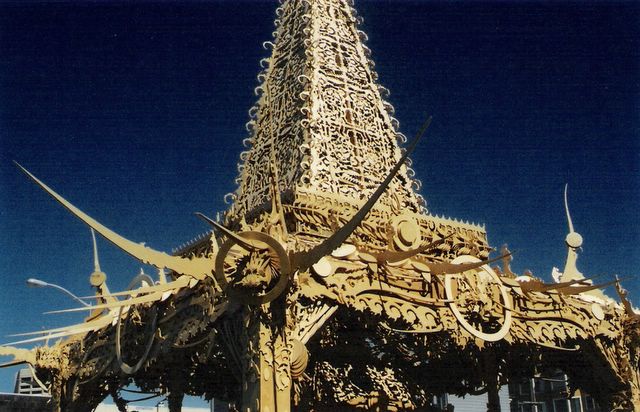
Hayes Green temple in its cleaner days
En route to the post office this afternoon, I walked through Hayes Green (the mini park at the end of my street) to discover that David Best's temporary wooden temple was finally being dismantled and taken away, to which I could think only Thank God!
The temple, built of hundreds and hundreds of intricately cut pieces of wood, was assembled in the middle of the green early this summer to celebrate the completion of Octavia Boulevard and the birth of our new little park. For a long time, it was a gathering spot, a marvel for neighborhood residents and visitors alike, and a pleasant centerpoint for the park. Encouraged by the temple's creator, people covered it in often thoughtful, sometimes heartbreaking, generally tasteful graffitti.
But then the months wore on, and the interesting inscriptions were more or less obliterated by gigantic puffy-lettered, spraypainted tags. The wood got dirty. The surrounding benches and planters and sidewalks got tagged. The temple limped to the point of being more an eyesore than a sign of celebration, and was still attractive only from a distance or at night, when it was too dark to see any of the inscriptions clearly.
So I'm glad to see it go, though I'll no longer be able to refer to it as a landmark when giving directions to my house, and I'll sort of miss the sight of the spire from elsewhere in the neighborhood. But it wasn't meant to stay forever, no matter how much I may've grown used to it.
Subscribe to:
Posts (Atom)


